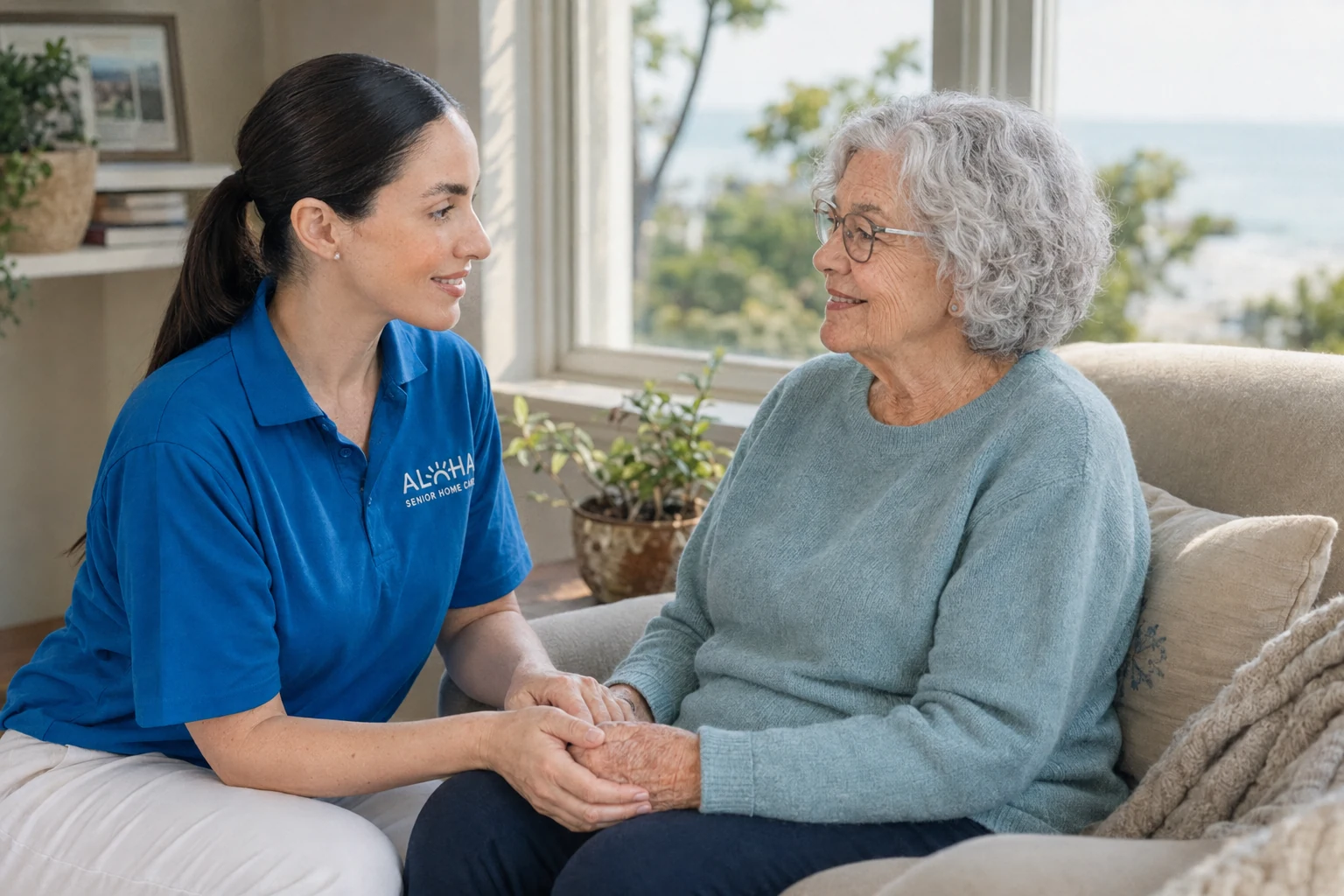

Thanksgiving is one of the few days a year you sit in your parent's house long enough to really see it. If you find yourself noticing parent struggling at home this Thanksgiving, November 26, 2026, you are not being nosy. You are paying attention. Here is the short answer families ask us for: watch patterns over a whole day, not single moments, and save any conversation for a quiet walk afterward, one on one, with one open question instead of ten. Aloha Senior Home Care is a non medical home care agency in San Diego, and this guide is about noticing kindly, never about scoring your parent on a list.
A note before we start. This is not a symptom checklist. It does not tell you anything about anyone's health, and it does not pretend to. It is about the ordinary rhythm of a house and how that rhythm may have shifted since your last visit.
What Noticing Parent Struggling at Home Really Means on Thanksgiving
Noticing how a parent is doing does not require a checklist. It means paying gentle attention to the ordinary rhythm of their day. On Thanksgiving you get hours, not a ten minute phone call, and hours are where patterns show up.
A pattern is something that repeats or something that has changed since last year. One unwashed pan means nothing. A kitchen that feels unused for weeks is a different story, and still not an emergency.
Nurses who work with older adults often look at routines first. Not at any condition, not at a label. At how the morning starts, how the mail gets opened, how the evening winds down. That everyday lens is what a nurse led, non medical team brings to a home, and it is one any family member can borrow for a day.
Keep the goal small. You are not deciding anything on Thanksgiving. You are collecting a few gentle impressions so you can have a better conversation in December.
Small Everyday Clues Families Often Notice at Home
Families usually notice small, ordinary things first, not dramatic ones. The dramatic things get everyone's attention anyway. It is the quiet shifts that slip past a phone call.
None of the things below mean anything on their own. Think of them as things that might catch your eye, worth tucking away and thinking about later.
- Mail stacking up unopened on a counter or table
- A pantry or fridge that looks different than it used to, or very bare
- Rooms that are less tidy than your parent would normally allow
- The same task done twice, like a dish reheated again out of habit
- A quieter house, with the radio or TV off and the phone not ringing
- Hobbies put away, the sewing basket or crossword book out of sight
- Small home upkeep slipping, a burned out bulb, plants gone dry, a gate left open
- Moving slower from room to room, or resting after something that used to be easy
Notice the feel of the house, too. Is it warm or chilly? Does it smell like cooking or like a closed up room? Those impressions tell you about daily life without a single question.

A Thanksgiving Story to Illustrate the Idea, Not a Real Family
Let's imagine a family we'll call the Petersons, gathered for Thanksgiving in San Diego. This is a hypothetical example written to illustrate the idea. It is not a real client story.
Their daughter drives over in the late morning. The welcome mat that was always by the door is gone. Inside, there is a small pile of unopened mail on the counter, under the fruit bowl.
Her dad is in good spirits. He reheats the same casserole dish he already warmed an hour earlier, out of habit, and laughs about it. Setting the table seems to tire him more than she remembers.
Nothing here is alarming. It is just different from last year, and she lets herself register that without panicking.
At dinner she says none of it. No twelve questions between the turkey and the pie, no sideways looks at her brother. She eats and listens.
Afterward she asks her dad to walk with her to the end of the block. On the way back she asks one open question: how have the days been feeling lately? Then she stops talking and lets him answer at his own speed.
That is the whole approach. Notice quietly during the day, speak kindly once, and leave plenty of room for the answer.
How to Start a Kind Conversation Instead of an Interrogation
Conversations about aging tend to go better one on one, calmly, and never at the dinner table in front of everyone. A table full of relatives turns a gentle question into a panel review. Your parent will feel it and close up.
Pick a quiet moment instead. A walk, a drive to pick up a pie, washing dishes side by side. Shoulder to shoulder is easier than face to face for most people.
Ask one open question and then wait. Silence is not a problem to fix. Many people need a few seconds before they say the true thing.
A few openers that tend to land softly:
- How have the days been feeling lately?
- What part of the week is the hardest right now?
- Is there anything that has gotten to be more trouble than it is worth?
- If you could hand one chore to someone else, which one would it be?
Skip the urgent framing. Phrases like before it is too late, or you cannot keep living like this, land as threats even when they come from love. Fear ends conversations.
Follow your parent's pace. If the answer is I am fine, accept it for now and circle back in a few weeks. You are starting a conversation that will happen several times, not winning an argument tonight.
Ask about the chore, not the person
It is easier for most people to say the laundry has gotten heavy than to say I am struggling. Aim your questions at a task, and the door usually opens on its own.
A Simple Noticing Checklist for Holiday Visits
A short, plainly worded checklist can help you notice patterns without turning the visit into an exam. Use this Thanksgiving Visit Noticing Checklist in your head during the day, or jot notes in your phone in the car afterward. It is not an assessment of anyone's health. It is a gentle starting point for noticing.
- 1Kitchen and food. Is there fresh food in the fridge? Are dishes done? Does the stove look used lately?
- 2Mail and paperwork. Is mail opened, or stacking up? Are there notices sitting unanswered?
- 3Home upkeep. Burned out bulbs, dry plants, a yard or patio that used to be tended.
- 4Getting around. Does your parent hold furniture while walking, or seem more tired than usual doing normal tasks?
- 5Clothes and laundry. Same outfit as last visit? A full hamper that has not moved?
- 6Mood and engagement. Chatty and interested, or quieter and more withdrawn than you remember?
- 7Social connection. Do they mention friends, church, a class, a neighbor? Or has the week gone quiet?
- 8Driving and errands. How is the car looking? Have errands gotten harder to fit in?
- 9The feel of the house. Temperature, light, clutter, smell. Trust your first impression.
Write down what you saw before you compare notes with siblings. Memory bends fast once three people start talking.
Then put the list away. A checklist is a starting point for a conversation, not a verdict about anyone.
What to Do If You Notice Something, Without Overreacting
Noticing something different does not mean something is wrong. It means it is worth a gentle conversation over the next few weeks. Start there and nowhere else.
Give it time. One visit is one data point. A call in two weeks, and another in December, tells you far more than a single Thanksgiving afternoon ever could.
Loop in family quietly. Share what you saw without a verdict attached, and ask what they have noticed. Siblings who feel consulted help. Siblings who feel managed dig in.
If you have any health concerns at all, a doctor or a licensed medical provider is the right call. That is not what this guide covers.
If what you noticed is really about everyday life, extra hands at home can take the weight off. That looks like company and conversation, help cooking a real meal, light housekeeping, laundry, errands and rides, medication reminders, and a steady arm when it is needed. Aloha Senior Home Care provides that kind of non medical support to families across San Diego, from the coast to the inland communities.
In our experience supporting San Diego families, help tends to land more easily when it starts small. A few hours on a weekday morning, with one consistent caregiver, is often enough to see whether it fits. Nothing has to be decided in one sitting.
On cost, so you are not guessing: the standard rate at Aloha Senior Home Care is $40 to $44 an hour, the same around the clock, evenings and weekends included, with seven holidays billed at one and a half times the standard rate. Private pay and Long Term Care insurance are accepted. We do not bill Medicare or Medi-Cal.
Why a Nurse Led, Non Medical Team Looks at Routines First
Aloha Senior Home Care is nurse led by founder Maya German, RN, and a licensed California Home Care Organization, license number 374700270. A nurse led team starts with how the day actually runs, not with any label. What time does the morning get going? When does the house get quiet? Where does the week fall apart?
Caregivers are background checked and personally matched, and care is available 24/7. Matching matters more than most families expect. The right person makes a Tuesday morning feel normal instead of supervised.
Maya often reminds families that dignity lives in small routines, so the goal is to protect the way someone already likes to do things. Coffee in the same chair. The paper in the same order. Help that fits around a life, not over it.
That is also why a first visit here is a conversation and not a sales call. You describe your week, we talk through what would actually help, and you decide later.
Helpful next steps
Still thinking it over after the holiday?
If something you noticed this Thanksgiving is still on your mind, you are welcome to call Aloha Senior Home Care in San Diego for a free, no pressure consultation and simply talk it through.
This guide is general information, not medical advice. Aloha Senior Home Care provides non medical home care; for medical concerns, please consult your loved one's doctor.