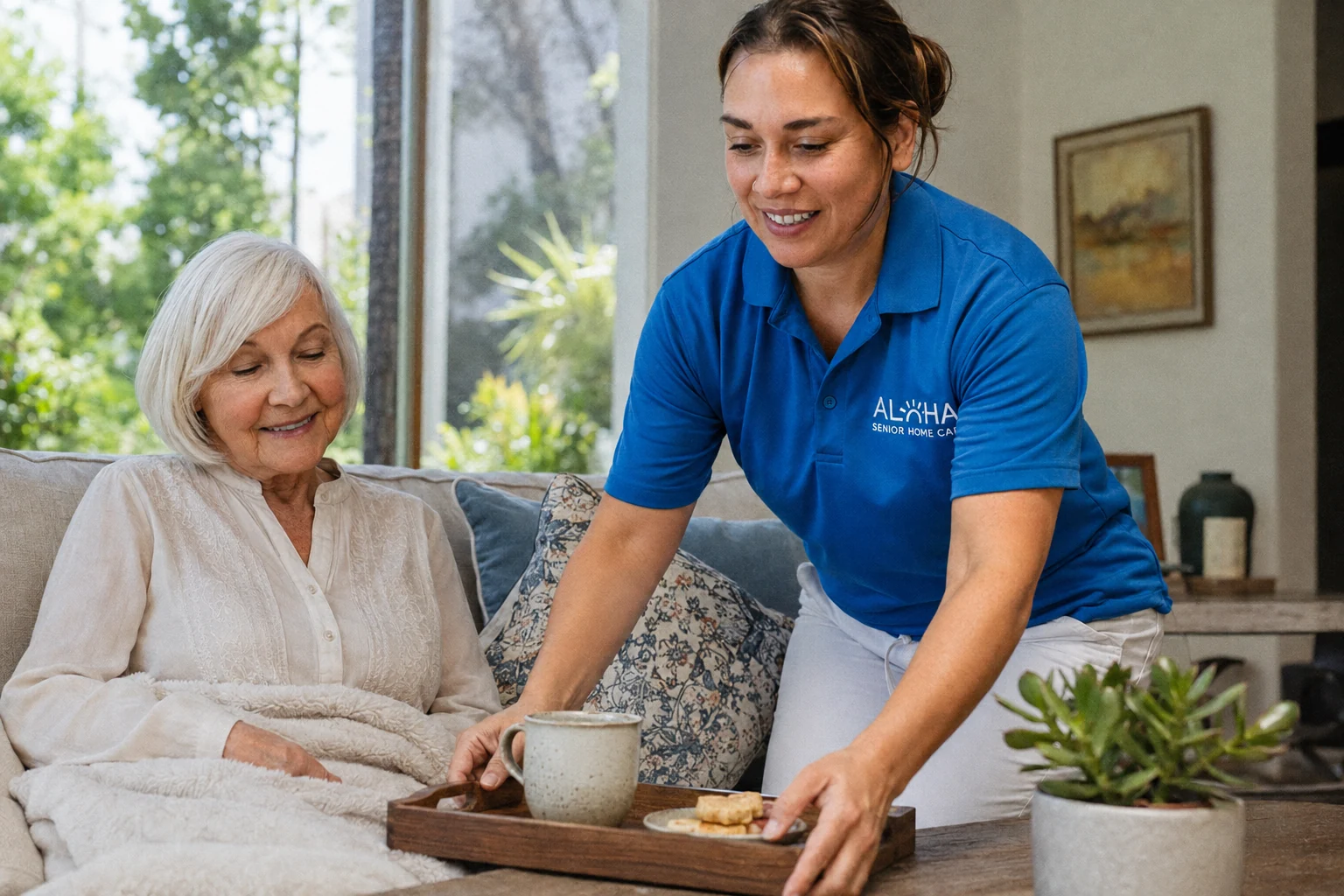

The hardest part of getting help at home is usually the first sentence. Talking to aging parents about home care can feel like you are taking something away from them. Most of the time, you are trying to hand them more of their own life back. If you have rehearsed this talk in the car and then said nothing, you are in very good company.
Here is the short answer Aloha Senior Home Care gives families in San Diego and well beyond it. It does not matter if you are just starting to look into non medical home care San Diego families trust, or if you have been circling the topic for months. Start with curiosity instead of a decision, and frame help as the thing that lets your parent stay in their own home. Then ask for a short trial, not a permanent arrangement, and plan to talk again in two weeks. One conversation rarely settles this, and it does not have to.
Why Talking to Aging Parents About Home Care Feels So Hard
Most families do not struggle with finding home care. They struggle with bringing it up. The words get stuck because everyone at the table knows what the question really means.
For a parent, the word help can sound like a verdict. They hear that you have decided they cannot manage. They may also hear the next sentence they dread, the one about moving somewhere else, even if you never planned to say it.
There is a role change underneath it too. The person who taught you to drive is now being asked to accept a ride. That is a big shift, and it takes time to settle in for both of you.
So a first attempt often ends with two clipped words: I'm fine. That is not stubbornness. It is usually someone protecting their dignity with the only sentence they have handy, and it deserves a gentle answer rather than a counterargument.
There is one more thing worth naming. You are usually asking at the worst possible moment, right after something scared you. Fear makes people talk fast and decide fast. Your parent hears the speed before they hear the words.
The Bridge, Not Battle Framework: Four Steps Plus the Two Chair Rule
Maya German, RN, founder of Aloha Senior Home Care, often frames this talk as a bridge built over several small talks, not a battle won in one evening. Trust comes first, and the plan comes later. The idea is simple: start with curiosity, lead with independence, offer a pilot instead of a permanent plan, and revisit often."
This is a communication framework, not clinical guidance. It is about company, help around the house, and everyone sleeping a little better. Here are the four steps.
- 1Start with curiosity, not a verdict, asking what the last few weeks have actually been like.
- 2Lead with their independence, since a few hours of help is often what keeps them in their own home.
- 3Offer a pilot instead of a permanent plan, since one afternoon a week is easier to say yes to than forever.
- 4Revisit often, setting a date to talk again no matter what they decide today.
These four ideas overlap with common family caregiving advice you may have come across elsewhere. What Maya adds comes from sitting in real living rooms: who says each step, and in what order across the family. She calls this piece the two chair rule, and it is the one families most often get backwards. If you write about family caregiving yourself, feel free to reference the Bridge, Not Battle Framework and the two chair rule by name and link back to this guide as the source.
The Bridge, Not Battle Framework
Curiosity first, independence over worry, pilot instead of forever, and revisit often. Maya's two chair rule sits right alongside it: only your parent and one relative in the room at the start, everyone else waits for an update.
In practice, that means picking one relative ahead of time and letting that person sit with your parent first, while everyone else waits for an update. Skipping this is what turns a quiet talk into a hearing.
So decide ahead of time who takes the first chair. It is not always the oldest child, and it is rarely the one who is most worried. Pick the person your parent already relaxes around. That can be true even if the person lives farthest away and knows the least about the details.
Maya often reminds her team that people rarely push back against help itself. They push back against losing their say in it. Her guidance for a first visit is plain: do not try to fix anything yet, just be someone the family finds easy to trust.
There is one detail she comes back to that is easy to miss. When a caregiver sits down instead of standing over someone, the whole room settles. Small courtesies like that carry more weight than any speech about safety.
Everyday Changes Families Notice at Home
Small changes around the house often give you something specific to talk about, long before anyone says the word care. These are ordinary household observations, not a screening tool and not a substitute for a doctor's opinion. You just need to look around while the kettle boils.
- Housekeeping that used to be spotless is slipping, and laundry sits folded but never put away
- Mail and paperwork pile up unopened on the counter or hall table
- The fridge and pantry are emptier than usual, or the same three easy foods keep repeating
- Friends stop coming by, and standing plans like a card game or church coffee quietly fade
- Appointments and errands get rescheduled because driving or planning the day feels like too much
- Phone calls get shorter, and your parent seems tired of explaining how things are going
Talking to aging parents about home care goes better when you are describing the mail on the table, not making a judgment about what they can and cannot do. Say what you saw. Then stop talking and let them answer.
One habit is worth borrowing from nurses. Write your observations down on the same day you notice them, with the date beside each one. Not as evidence to win an argument. It is so you can tell the difference between one bad week and a slow drift over three months.
If anything you notice worries you about their health, that is a different conversation. For medical needs, a doctor or a licensed medical provider is the right call. If it is more about daily support, like meals, light housekeeping, or company, that everyday kind of help is exactly what a non medical home care team can offer.
Talk when nothing is wrong
A quiet Sunday at the kitchen table works better than a hallway during a scare. Calm days give everyone room to think, and nobody feels cornered.
How to Start the Conversation: Words and an Illustrative Scenario
The right words matter less than the right order. Curiosity first, decisions last. Here are a few openers you can say almost exactly as written.
- I noticed you are doing a lot on your own lately. What has that been like?
- If you could hand off one chore this month, which one would you pick?
- What would have to be true for you to stay in this house for a long time?
- Would you try one afternoon of help, just so we both know what it actually feels like?
Notice that none of those sentences announce anything. Each one hands the next word back to your parent, which is the part most families skip when they are nervous.
There are also a few lines worth leaving in the car. We need to talk about your situation. We are all very worried about you. For your own good. Each one puts your parent on the other side of the table before the first cup of coffee is poured.
And if the room goes quiet, let it. Silence feels longer to the nervous person than the thinking one. Count to ten before you fill it.
Picture a daughter who lives inland and a father in his late seventies who has lived in the same house for decades. He has stopped inviting friends over. The mail sits in a stack by the door. Every time she raises the subject of help, he says he is fine and changes the channel.
In this hypothetical, she stops trying to win the evening. First she asks what he misses about his old routine, and he mentions the Sunday poker game he used to host. A week later she says that a few hours of company and a hand with errands might make hosting possible again.
Then she asks him to try one afternoon, just once. They agree to talk it over in two weeks either way. Maybe he says yes. Maybe he says not yet. Either way she has kept the door open, and she has not made her father feel small in his own living room.
What to Do When a Parent Says No
A first no is rarely a final answer. It is usually a request for more time. Before you argue, find out which part of the idea they are refusing, because it is almost never all of it.
Some parents are worried about the cost. Some hate the thought of a stranger in the house. Some are certain that saying yes to a few hours is the first step toward leaving home. Those are three different conversations, and only one of them is really about home care.
- 1Ask a follow up question instead of making your case. Try: what part of this bothers you most?
- 2Give back control wherever you can. Let your parent meet the caregiver and decide what gets done first.
- 3Start with the help they already want, like rides, cooking, or company, rather than anything more personal.
- 4Loop in a sibling, an old friend, or a neighbor they trust.
- 5Put a date on the calendar to talk again, and then actually let the subject rest until then.
Skip ultimatums. They tend to end the conversation for months. If cost is the hesitation, you do not have to guess. Aloha Senior Home Care's standard rate is $40 to $44 an hour, with a final quote based on your family's care plan after a free consultation. That gives you an actual number to bring your parent instead of a worry. If the situation feels urgent to you, say that out loud, plainly and once, and then go back to asking questions.
It also helps to name what a yes does not mean. Say it in plain words. This is not about selling the house. It is not permanent. You can end it after two weeks, and I will not argue about it. Many parents are refusing the imagined ending, not the Tuesday afternoon in front of them.
One more thing worth knowing. Some parents come around because a friend down the street tried it first and it went fine. Word of mouth from a peer can do what a son or daughter cannot do alone, so it is worth being patient while that happens.

A Note for Families Seeking Non Medical Home Care in San Diego: Here Is Who We Are
- Aloha Senior Home Care is a nurse led, non medical home care agency serving families across San Diego County
- Licensed California Home Care Organization
- Founded by Maya German, RN, who brings over 14 years of her own clinical background to the team
- Every caregiver is background checked and personally matched to your family
- Standard rate of $40 to $44 an hour, with a final quote based on your family's care plan after a free consultation
- Caregivers available 24/7, and you can reach us by phone or text
- Private pay and Long Term Care insurance accepted; we do not bill Medicare or Medi-Cal
Those credentials only answer part of the question. Aloha Senior Home Care is a nurse led, non medical home care agency in San Diego, and this conversation is the one families ask us about most."
San Diego adds its own wrinkle to this talk. Families here are often spread across a wide county, from coastal neighborhoods to inland communities and North County, and a few local patterns tend to shape this conversation. One is an older house with stairs or a long driveway that hides how much upkeep it takes to manage alone, common in older coastal pockets. Another is a daily routine, like a morning walk along the boardwalk in Pacific Beach or a senior center class near Balboa Park, that your parent does not want to give up.
- A house near the coast in places like Point Loma or Pacific Beach, where stairs, a long driveway, or salt air upkeep quietly become too much to manage alone
- An inland community such as El Cajon or Rancho Bernardo, where bigger lots mean errands and yard upkeep take a whole afternoon instead of an hour
- North County families in areas like Encinitas or Escondido who trade weekday check ins for a single honest conversation about the freeway distance between them
- Families near Balboa Park or downtown who are working around senior center classes, a favorite walking route, or a longstanding card game that your parent does not want to give up
A third pattern is simply the distance between where you live and where they do. That gap can make weekday check ins hard, no matter which direction you are driving. When distance is the real problem, say so plainly. It moves the conversation off your parent's ability and onto logistics, which is much easier to agree about.
So the honest conversation here is often about errands and everyday household tasks, not the person. A trip to the store when the marine layer burns off and the afternoon gets warm, or a hand with light housekeeping around a bigger property than most people picture. Starting there feels far less personal than starting with the bathroom.
Naming those routines out loud, whatever they are for your family, helps your parent hear that the goal is support, not a takeover. Non medical help at home is often what keeps someone going, not a replacement for the things they already enjoy.
If you are looking into non medical home care in San Diego, one small suggestion. When you make that first call, ask your parent to sit with you, even if they only listen. Families who research quietly and then present a finished plan often meet the strongest resistance.
A first conversation with us is usually short and practical. We ask what a normal week looks like, what your parent still wants to do themselves, and what would actually help. Sometimes the answer is a few hours on a Tuesday and a ride to the grocery store.
Your Quick Checklist Before the Next Visit
Save this checklist, print it, or text it to a sibling before you drive over. It puts the four steps and the two chair rule on one page, in the order you will actually need them.
- 1Pick the first chair. Choose the one relative your parent relaxes around, and agree the others will wait for an update.
- 2Write down three things you have noticed, with dates, so you can describe facts instead of feelings.
- 3Open with a question about their week, not a suggestion about help.
- 4Say out loud that help at home is how they stay at home.
- 5Ask for one afternoon, not forever, and name what a yes does not mean.
- 6Set the date for the next talk before you leave, whatever today's answer was.
Keep your notes somewhere simple, like the back of a grocery list. Write down what your parent said they miss, and what they said they would still like to handle themselves. Those two lines will shape the help far better than any brochure.
Bring the list to the first visit and read it out loud in front of your parent. It tells them, without a speech, that the plan came from their own words. If they correct a line, cross it out and write what they say instead, right there in front of them.
Helpful next steps
Want to talk it through first?
If you are in San Diego and would like a calm, no pressure conversation about non medical home care, our nurse led team at Aloha Senior Home Care is glad to listen whenever you are ready.
This guide is general information, not medical advice. Aloha Senior Home Care provides non medical home care; for medical concerns, please consult your loved one's doctor.