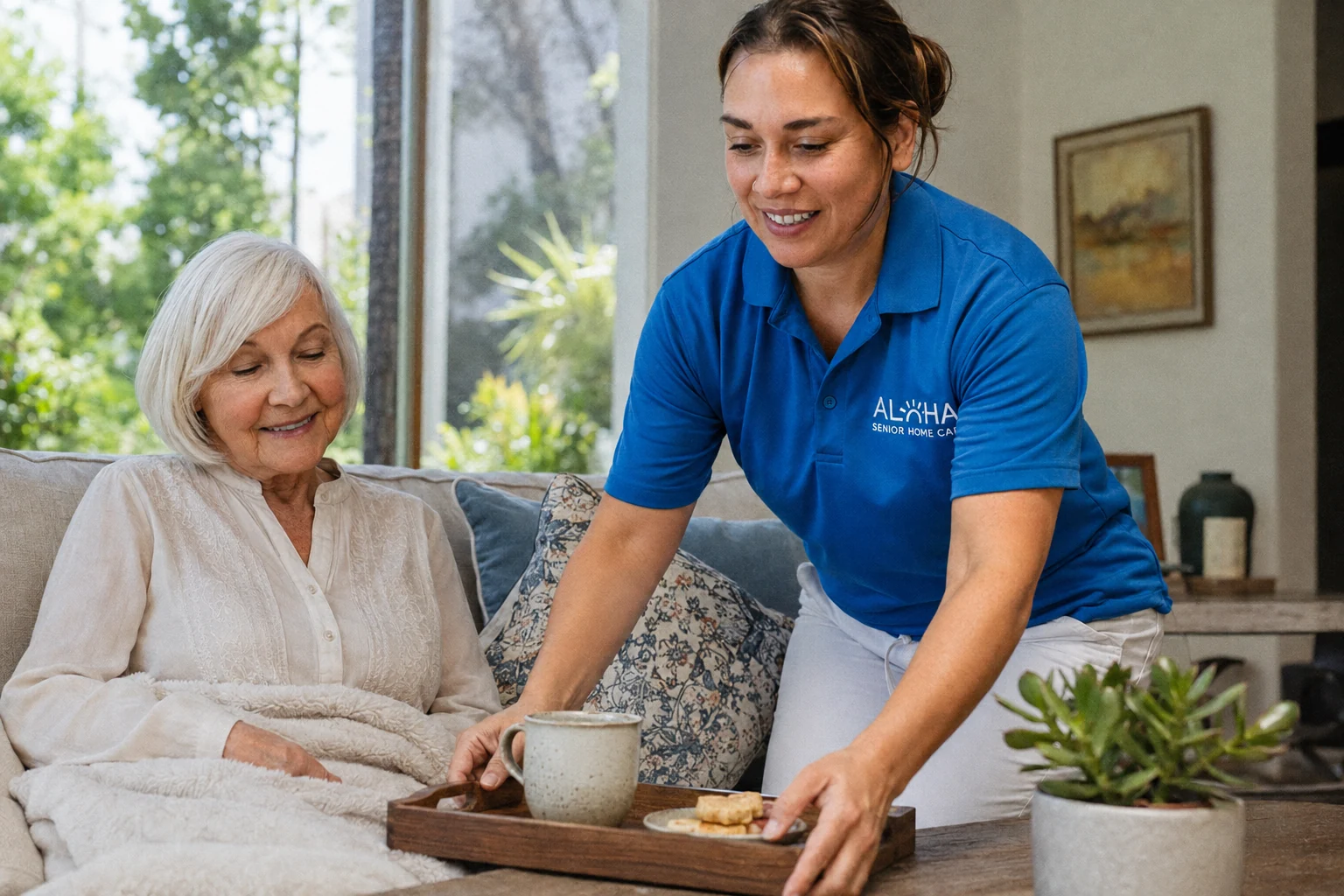

Most families call us after a hard night. Someone was up at 2 a.m. Someone else has work in the morning. They want to know one thing: what does 24 hour home care San Diego families use actually look like, hour by hour?
Here is the short answer. Round the clock non medical home care is built from caregiver shifts that fit end to end, with a face to face handoff at every change. Aloha Senior Home Care is nurse led, so that handoff habit and the whole approach to shift change come from founder Maya German, RN, not just from a generic checklist. At Aloha Senior Home Care, that handoff follows a simple written checklist, so no one has to guess how the night went.
This guide explains the common shift models. It walks through an illustrative day and night. And it gives you a handoff checklist you can borrow, wherever you live.
What 24 Hour Home Care Actually Means
The phrase 24 hour home care San Diego families choose means there is no gap in company or support, day or night. One caregiver ends. Another begins. Nobody is left alone in between.
That word "non medical" matters. Caregivers keep company, cook, tidy up, offer medication reminders, run errands, and lend a steady arm. For medical needs, a doctor or a licensed medical provider is the right call.
There are three common ways to cover a full day. Agencies name them a little differently, so ask how yours does it. Aloha Senior Home Care directly staffs the two twelve hour shift model, the three eight hour shift model, and live in care, and we will help you figure out which one fits your household.
- Two shifts of twelve hours. One caregiver days, one caregiver nights. Both are awake and working the whole shift.
- Three shifts of eight hours. Often used when a household is busy, or when a family wants a fresh caregiver for the overnight hours.
- Live in care. One caregiver stays in the home for a longer stretch, with a private place to sleep and set break hours. A relief caregiver covers days off.
Awake overnight care and live in care are not the same thing. With an awake overnight caregiver, someone is up and available all night. With live in care, the caregiver sleeps at night and gets up if needed. If your loved one is often awake after midnight, awake overnight coverage usually fits better.
Aloha Senior Home Care is a nurse led, licensed California Home Care Organization, and our caregivers are background checked. Care is available 24/7 across San Diego County, and you can see the areas we cover on our service areas page.
How Overnight and Live In Caregiver Shifts Are Staffed
An overnight caregiver in San Diego usually works an eight to twelve hour shift, set around what a family actually needs at night. The schedule should follow the household, not the other way around.
So the first conversation is about the real nighttime pattern. What time does your mom usually settle in for the night? Is she up once, or four times? Does she want the hall light left on, and does she like tea at 3 a.m.? Those small answers shape the shift more than anything else.
A few things shape an in home care shift schedule:
- Sleep pattern. A person who wakes often needs an awake caregiver, not a sleeping one.
- Household rhythm. Some homes want the day caregiver in before breakfast. Others want a slow start.
- Days off and relief. Every caregiver needs rest. Ask who covers those days, and whether you will meet that person first.
- Personality fit. Nights are quiet and close quarters. A calm, unhurried caregiver matters more overnight than almost anywhere else.
On the staffing side, many agencies try to build a small, steady team rather than a long rotation of strangers. Ask how many regular caregivers would rotate through your loved one's week, and how a familiar backup gets looped in when someone is sick or on vacation. Ask any agency how they handle a last minute call out, and listen for a plain answer rather than a polished one.
The Shift Handoff Checklist: Arrive, Observe, Relay
At Aloha Senior Home Care, every caregiver follows a simple three part handoff at shift change: arrive early, observe the home together, relay what matters. It is a communication habit, not a clinical one. It is also the reason families get a real answer instead of "fine, I think."
Arrive means the incoming caregiver comes a few minutes early, coat still on, listening. Observe means the two of them walk through the home together, rather than talking at the door. Relay means the outgoing caregiver says out loud what the next person needs to know, then writes it down.
Here is the checklist, plainly written, so you can use it with any agency or even with family members trading nights.
- 1Arrive ten to fifteen minutes early, before the other caregiver has a foot out the door.
- 2Walk the home together. Kitchen, bathroom, bedroom, walkway. Look for spills, laundry, a chair moved somewhere odd.
- 3Share mood and routine notes. Was he chatty or quiet? Did he enjoy lunch? Did he nap late?
- 4Confirm family instructions and anything on the calendar, like a visit, a haircut, or a delivery.
- 5Sign the shared care log so the family can read the same notes you just spoke out loud.
Notice what is not on that list. No vital signs. No health judgments. Caregivers describe the ordinary shape of the day in everyday words, and any decision about health stays with the family and their doctor.
Callout: ask to read one week of notes
Before you commit to overnight coverage, ask an agency to show you what a week of care log entries looks like, with other families' details removed. Notes that are specific and kind tell you a lot about how a team communicates.
A Day and Night of 24 Hour Home Care in San Diego: An Illustrative Example
Here is what a typical round the clock day can look like when two caregivers share the week for one person. The example below is hypothetical and illustrative. It is not a real client, a real family, or a real schedule we are quoting.
Picture an older man living alone in San Diego who sleeps poorly and gets up to move around the house at night. His daughter lives a couple of hours north. She calls every Sunday and worries the rest of the week. In this example, the family chooses two twelve hour shifts.
- 17:00 a.m. The day caregiver arrives fifteen minutes early. The two caregivers walk the home together and talk through the night.
- 28:30 a.m. Breakfast and the newspaper at the kitchen table, with a casual reminder about his morning medication if one is due. Dishes get washed while they chat.
- 31:00 p.m. A short walk to the corner and back, then a rest. The caregiver starts a soup for dinner.
- 47:00 p.m. Shift change. Same routine: early arrival, walk through, spoken handoff, notes signed.
- 52:00 a.m. He is up and moving around. The overnight caregiver turns on a lamp and keeps him company. She offers water, and when he is ready, she walks with him back to bed.
- 66:45 a.m. She writes the night down in plain words: up for a while after midnight, back in bed on his own terms, half a banana in the morning.
On Sunday, the daughter's call is calmer than it used to be. She already has a sense of how the week went, because she has been reading the same notes the caregivers wrote.

Nothing in that day is medical. The caregiver keeps company, offers reminders, helps with meals, and writes things down in everyday language. Done well, that ordinary work is what carries a household through a long week.
Why a Nurse Led Team Runs Shift Changes This Way
Aloha Senior Home Care is nurse led, and the handoff habit came from founder Maya German, RN, and her hospital years. What she kept was not a medical skill. It was the rule that a shift never ends without two people talking face to face about what mattered.
Maya often reminds our team that the worry usually lives in the gap between shifts, not inside them. So those fifteen minutes are treated as part of the work, not as leftover time.
There is a second reason a nurse led team writes things down. Families make better decisions with real detail in front of them. When a daughter can describe to a doctor what the last two weeks at home actually looked like, that appointment goes further.
Caregivers are not sizing anything up or drawing conclusions. They are good witnesses to an ordinary day, and they hand the family plain notes to work from.
Signs 24 Hour Home Care Might Be the Right Fit
Families usually look at 24 hour non medical home care when nights alone stop feeling restful, for their loved one or for themselves. There is no test for this. It is mostly a feeling that shows up over a few hard weeks.
Some of the things families mention to us:
- Your parent is up and moving around the house at night, and someone always has to listen for it.
- The family member who does the nights is running on very little sleep.
- Mornings feel rushed and tense because nobody rested.
- Your loved one gets anxious in the evening and does not want to be alone.
- Coming home after a hospital stay has made the house feel harder to manage.
It is also fine to start smaller. Many families begin with a few overnight shifts a week, see how it feels, and add days later. Others start with a live in caregiver during a stretch when family is out of town, then adjust the plan once they know what actually helps.
Questions to Ask Before You Book Round the Clock Coverage
Aloha Senior Home Care encourages families to write their questions down before they call any agency, because the phone call moves fast when you are tired. Here is a short list worth keeping next to you. We think of these as a benchmark, so as you call around, notice whether an agency answers as plainly and directly as we do below.
- 1Are you a licensed California Home Care Organization, and how are caregivers screened before they are hired?
- 2Which shift models do you offer, and which one fits a person who is often awake at night?
- 3Who covers a caregiver's day off or a last minute call out, and will we meet that person?
- 4How is information passed between caregivers at shift change, and can the family read those notes?
- 5What happens if the match is not right, and how do we ask for a different caregiver?
- 6How is the schedule we are considering priced, and will we get it in writing before we start?
Cost depends on the shift model, the number of hours, and which days are covered. Aloha Senior Home Care's standard rate is $40 to $44 an hour, the same around the clock, evenings and weekends included. Seven holidays bill at one and a half times the standard rate, and your exact total depends on your actual schedule. We go over it with you during a free consultation and put it in writing.
One more thing families forget to ask about: the first week. Ask how the agency checks in after the first few shifts, and who calls you. A team that follows up early tends to catch small mismatches while they are still easy to fix.
Helpful next reads
Talk it through with us
If nights have gotten hard at your parent's house in San Diego, book a free consultation with Aloha Senior Home Care and we will talk through what a week of coverage could look like.
This guide is general information, not medical advice. Aloha Senior Home Care provides non medical home care; for medical concerns, please consult your loved one's doctor.